
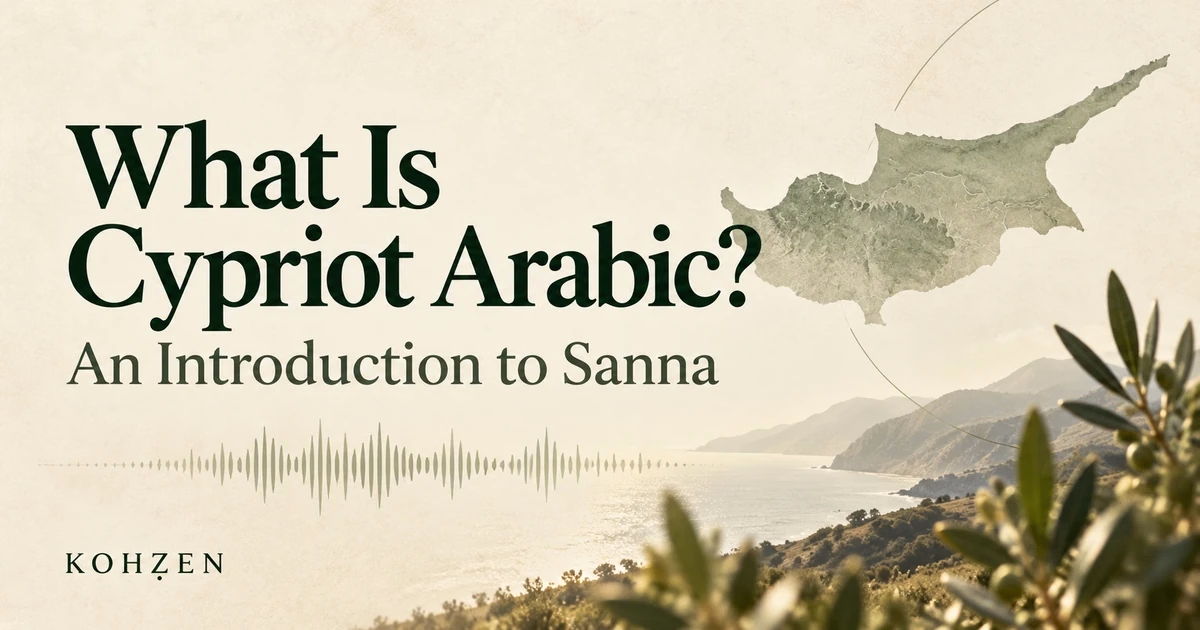
Cypriot Arabic, known as Sanna, is a distinctive variety of Arabic traditionally spoken by Cyprus’ Maronite community. Shaped by centuries of life on the island and contact with Cypriot Greek, it carries a linguistic heritage unlike any other.
Today, Sanna is severely endangered. But it hasn’t disappeared. Its words, expressions and stories survive through speakers, families, recordings and ongoing efforts to preserve the language.
So where did Cypriot Arabic come from? What makes it different from other varieties of Arabic? And what is being done to keep it alive?
- What is Cypriot Arabic (Sanna)?
- Where is Cypriot Arabic spoken?
- Who are the Cypriot Maronites?
- What makes Cypriot Arabic different from other Arabic varieties?
- Why is Cypriot Arabic endangered?
- What is being done to preserve Cypriot Arabic?
- Why preserving Sanna matters
- How Kohẓen is helping keep Sanna accessible
- Frequently asked questions
- Sources and further reading
What is Cypriot Arabic (Sanna)?
Cypriot Arabic, also called Cypriot Maronite Arabic, belongs to the wider Arabic language family. It developed in Cyprus over centuries, becoming distinct from the Arabic varieties spoken elsewhere in West Asia.
Its name, Sanna, is commonly understood by its speakers to mean our language.
Although Sanna has Arabic roots, it has also been shaped by prolonged contact with Cypriot Greek. This influence can be heard in aspects of its pronunciation and observed in its vocabulary and grammar.
That doesn’t mean Cypriot Arabic is simply a mixture of Arabic and Greek. It is a historically developed language variety with its own characteristics and linguistic history.
In fact, a 2023 linguistic study by Spyros Armostis and Marilena Karyolemou examines how contact with Cypriot Greek has influenced Sanna, drawing on natural speech recordings rather than relying solely on earlier written descriptions.
For linguists, Cypriot Arabic offers a fascinating example of what happens when languages develop in close contact over many generations.
For the community that speaks it, however, Sanna is much more than a subject of academic study.
It is part of a shared cultural inheritance.
Where is Cypriot Arabic spoken?
Cypriot Arabic is most closely associated with Kormakitis, also known as Kormajit, a historic Maronite village in north-western Cyprus.
For generations, Sanna formed part of everyday life in the village. It was spoken at home, between neighbours and during community gatherings.
The events of 1974 brought profound changes.
Following the Turkish military intervention and subsequent division of Cyprus, many Maronites were displaced from their villages. Families settled elsewhere on the island or moved abroad, disrupting the close-knit communities in which Sanna had traditionally been spoken.
This displacement has had lasting consequences for the language.
When communities become geographically dispersed, the everyday opportunities to speak and hear a minority language can diminish. Children may grow up speaking the dominant language of their surroundings rather than the language of their parents or grandparents.
Today, the heritage of Cypriot Arabic extends well beyond Kormakitis itself, through families and communities with connections to the village.
Yet Kormakitis remains central to understanding the language’s history and cultural significance.
Who are the Cypriot Maronites?
The Cypriot Maronites are a historic Christian community whose religious tradition belongs to the Maronite Church, an Eastern Catholic Church with roots in the Levant.
Their presence in Cyprus stretches back many centuries.
Over time, the community developed a distinct identity shaped by its religious traditions, its relationship with the island and its wider West Asian heritage.
Sanna is one expression of that identity.
But it is important not to assume that all Cypriot Maronites speak the language today.
For some families, Sanna remains a spoken language. For others, knowledge of it may be limited to particular words, expressions or memories of older relatives.
And for younger generations, it may be a language they recognise as part of their heritage without having had the opportunity to learn.
These different experiences are all part of the story of Cypriot Arabic.
What makes Cypriot Arabic different from other Arabic varieties?
One of the most interesting things about Sanna is the way it has developed.
Its Arabic foundations remain evident, but its long history in Cyprus has given it distinctive characteristics.
Linguists have identified changes in its sounds, vocabulary and grammatical structures, including features associated with contact with Cypriot Greek.
This makes Sanna different from contemporary varieties such as Lebanese, Syrian or Egyptian Arabic.
Although there are historical and linguistic connections between them, knowing one variety does not necessarily mean understanding another.
The University of Cyprus’ Sanna Oral Tradition Archive offers valuable insight into these differences by preserving authentic recordings of traditional speakers.
These recordings matter because a language cannot be fully understood through written descriptions alone.
Its rhythms, pronunciation, expressions and individual voices are equally important.
Hear Cypriot Arabic spoken
If you’ve never heard Sanna before, listening to a speaker is one of the best ways to begin understanding what makes the language distinctive.
The University of Cyprus’ audiovisual collection includes recorded stories from the Maronite community, accompanied by educational material.
These are not simply vocabulary exercises. They preserve memories and experiences associated with everyday life in Kormakitis.
At Kohẓen, we are also developing a collection of selected Cypriot Arabic recordings, presented with source information, working transliterations and English translations where available.
Our aim is to make these voices accessible to people who may never have had the opportunity to hear Sanna spoken in their own families.
Why is Cypriot Arabic endangered?
Despite its long history, Cypriot Arabic faces an uncertain future.
In a 2025 assessment of minority languages in Cyprus, the Council of Europe warned that Cypriot Maronite Arabic remains in danger of extinction.
The report recognised the support already provided by the Cypriot authorities, including educational activities and cultural initiatives.
However, it also highlighted serious challenges, particularly the shortage of trained teachers and the limited opportunities for children to learn the language.
This illustrates a central challenge in language preservation.
Official recognition is important, but it does not automatically ensure that a language will continue to be spoken.
For that to happen, younger generations need meaningful opportunities to hear, learn and use it.
The problem is therefore not only how to preserve the words of Sanna, but how to support the continuation of the language itself.
How many people still speak Sanna?
Reliable contemporary estimates are difficult to establish.
Some people speak Sanna fluently, while others may understand it without speaking it regularly. Still others know particular expressions passed down through their families.
These are different levels of language knowledge, and not every survey measures them in the same way.
Rather than relying on a single potentially outdated figure, it is more useful to recognise the underlying concern: the number of people using Cypriot Arabic in everyday life is limited, and transmission between generations is at risk.
What is being done to preserve Cypriot Arabic?
There is already important work taking place.
Since 2013, Cyprus’ Ministry of Education has supported a research programme dedicated to documenting and revitalising Cypriot Arabic.
One of its most significant outcomes is the Sanna Oral Tradition Archive, developed through research at the University of Cyprus.
The archive brings together recordings, interviews, educational resources and community experiences.
It includes projects such as Ten Small Stories in Sanna, which presents stories connected to life in Kormakitis, accompanied by audio recordings.
These materials help make the language accessible to younger generations while preserving valuable knowledge about the community’s past.
Such initiatives demonstrate that the preservation of Cypriot Arabic is not simply about recording a language before it disappears.
It is also about creating opportunities for people to reconnect with it.
Why preserving Sanna matters
Every language carries its own ways of expressing everyday experiences.
A familiar greeting, a family expression or a story told by a grandparent can hold meanings that go beyond a straightforward translation.
For Cypriot Arabic, these connections are particularly important.
Sanna has traditionally been transmitted through speech, making the voices of older speakers an especially valuable source of linguistic and cultural knowledge.
Recording those voices helps preserve more than vocabulary.
It can capture pronunciation, humour, personal memories and the context in which expressions were used.
But preservation must also involve care.
Recordings should be properly attributed, translations should be checked, and the wishes of speakers and those responsible for original material should be respected.
The goal is not simply to collect as much content as possible.
It is to make meaningful, reliable documentation available for people today and for generations to come.
How Kohẓen is helping keep Sanna accessible
Kohẓen is an independent Cypriot Maronite heritage project focused on documenting the language, voices, memory and living heritage of the community.
Our current work centres on Cypriot Arabic.
Through selected recordings, careful transliterations, English translations and cultural context, we aim to make the language more accessible beyond social media.
We also recognise that meaningful documentation requires accuracy, appropriate permissions and openness to correction.
Kohẓen is not a formal academic archive or a substitute for established language revitalisation initiatives.
Instead, it seeks to contribute to the wider preservation effort by making carefully documented material accessible to a broader audience.
Whether you speak Sanna, remember hearing it from relatives or are discovering it for the first time, we hope Kohẓen offers a place to explore and reconnect with this remarkable heritage.
Listen to Cypriot Arabic and explore Kohẓen’s recordings.
Frequently asked questions
Is Cypriot Arabic the same as Lebanese Arabic?
No. Although both are varieties of Arabic and share historical connections, Cypriot Arabic developed separately in Cyprus and has been significantly influenced by contact with Cypriot Greek.
What does Sanna mean?
Sanna is the community’s traditional name for Cypriot Arabic and is commonly understood to mean our language.
Is Cypriot Arabic still spoken today?
Yes. Sanna is still spoken, although its everyday use and transmission between generations are severely endangered.
Can you learn Cypriot Arabic?
Yes, although learning resources are relatively limited. The University of Cyprus’ Sanna Oral Tradition Archive provides recordings and educational materials that can help people become familiar with the language.
Where can I hear native speakers of Sanna?
You can explore authentic recordings through the University of Cyprus’ Sanna archive and selected material presented by Kohẓen.
Sources and further reading
- University of Cyprus: Sanna Oral Tradition Archive — language documentation, recordings and educational resources.
- Council of Europe (2025): Evaluation of minority language protection in Cyprus.
- Armostis, S. and Karyolemou, M. (2023): Contact-Induced Change in an Endangered Language: The Case of Cypriot Arabic, Languages, 8(1), 10.
- Borg, A. (1985): Cypriot Arabic: A Historical and Comparative Investigation into the Phonology and Morphology of the Arabic Vernacular Spoken by the Maronites of Kormakiti Village.
Keep our voices. Strengthen our community.
