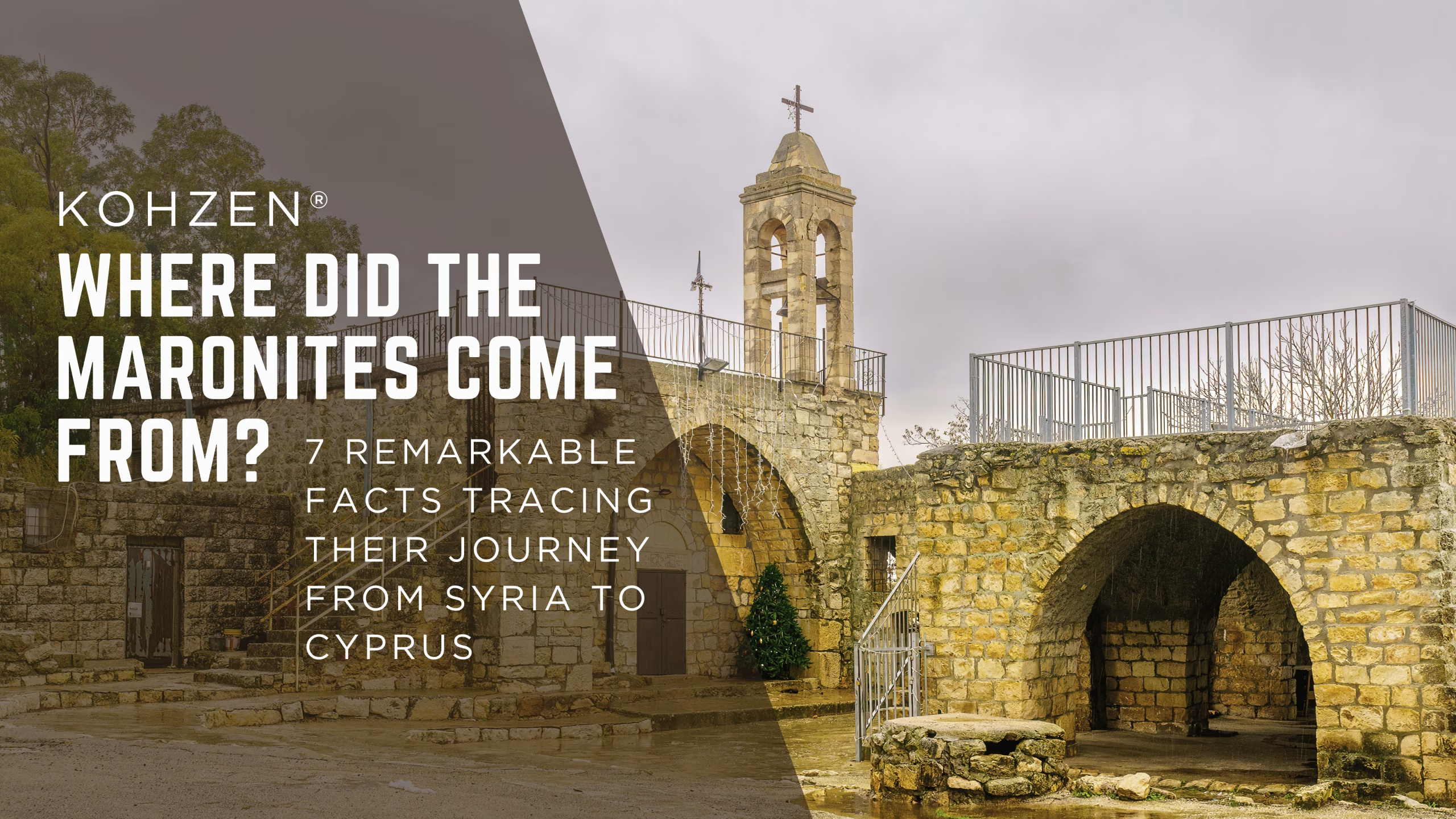
The Maronites are an ancient Christian community whose history begins in the Levant, particularly the territories of present-day Syria and Lebanon. Their story is also deeply connected to Cyprus, where Maronite communities have lived for more than a thousand years.
But where did the Maronites originally come from, why did they settle in Cyprus, and how did their language and traditions develop on the island?
Here are seven key aspects of their history, with a particular focus on Cyprus’s Maronite community.
- 1. The Maronites originated in the Levant
- 2. Maronites began arriving in Cyprus during the early Middle Ages
- 3. The Frankish period transformed the Maronite presence in Cyprus
- 4. The community gradually became concentrated in fewer villages
- 5. Cypriot Arabic (Sanna) preserves a distinctive linguistic inheritance
- 6. The events of 1974 profoundly disrupted Maronite village life
- 7. Cypriot Maronite heritage continues to evolve
- The Maronites of Cyprus: A living connection between the Levant and Cyprus
- Sources and further reading
1. The Maronites originated in the Levant
The Maronites take their name from Saint Maron, a Christian ascetic who lived in the region of present-day Syria during the late fourth and early fifth centuries.
A religious community developed around his spiritual tradition, particularly in the Orontes Valley. Over the centuries, Maronite communities became established in Mount Lebanon, which emerged as an important centre of their religious and cultural life.
Today, the Maronite Church is an Eastern Catholic Church in communion with Rome. It follows the West Syriac liturgical tradition, preserving a connection with Syriac, a form of Aramaic, in its worship.
This heritage reflects the community’s long history within the wider Christian traditions of West Asia.
2. Maronites began arriving in Cyprus during the early Middle Ages
The history of Cyprus’s Maronites is closely connected to successive movements of people across the eastern Mediterranean.
Traditional accounts identify several periods of migration between the late seventh or eighth century and the thirteenth century. These movements were shaped by political instability, religious conflict and changing patterns of settlement in the Levant.
An early migration is traditionally dated to 686 AD. Another is associated with the destruction of the Monastery of Saint Maron on the Orontes River in the tenth century.
The precise scale of these early migrations is difficult to establish. Historian Guita G. Hourani notes that documentary evidence for the earliest waves is limited, making it important to distinguish historical tradition from independently verifiable detail.
What is clear is that the Maronite presence in Cyprus developed over many centuries, rather than through a single migration.
3. The Frankish period transformed the Maronite presence in Cyprus
A particularly significant period began in 1192, when Cyprus came under the rule of Guy de Lusignan.
During the Frankish period, migration from the Levant contributed to the expansion of Maronite settlement on the island. Further movements followed the weakening and eventual collapse of the Crusader states, including the fall of Tripoli in 1289.
Maronite communities became established across parts of northern Cyprus, particularly around the Pentadaktylos mountain range.
Historical accounts describe dozens of Maronite villages during the medieval period. Some sources suggest more than sixty settlements at the community’s height.
Population estimates from this period differ considerably, however, and should not be treated as precise census figures.
The important historical point is that medieval Cyprus supported a substantial and geographically dispersed Maronite community.
4. The community gradually became concentrated in fewer villages
The Maronite presence in Cyprus changed considerably under Venetian and Ottoman rule.
Successive political and religious upheavals, economic pressures, migration, and assimilation affected the community over several centuries. Historical records describe a gradual reduction in the number of identifiable Maronite settlements.
By the twentieth century, four villages had become particularly associated with Cypriot Maronite life:
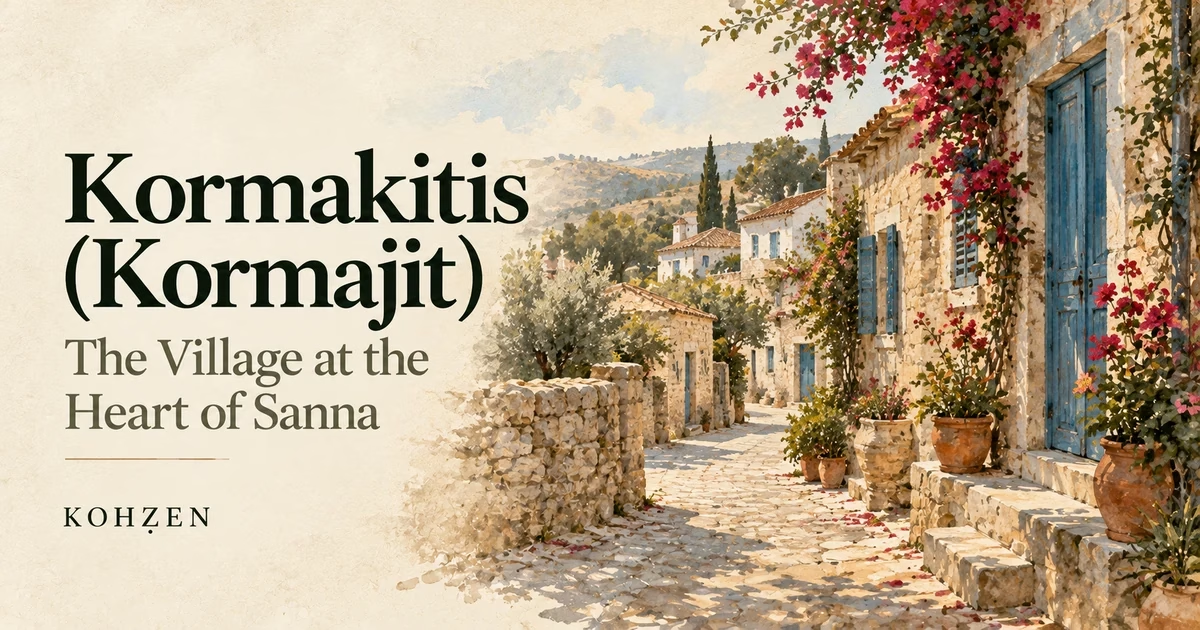
- Kormakitis (Kormajit)
- Asomatos
- Ayia Marina (Agia Marina)
- Karpasha (Karpaseia)
These villages were not simply places of residence. They were centres of family life, religious observance, community relationships and cultural transmission.
Their importance remains deeply felt among Cypriot Maronites today, including families whose descendants now live elsewhere in Cyprus or across the diaspora.
5. Cypriot Arabic (Sanna) preserves a distinctive linguistic inheritance
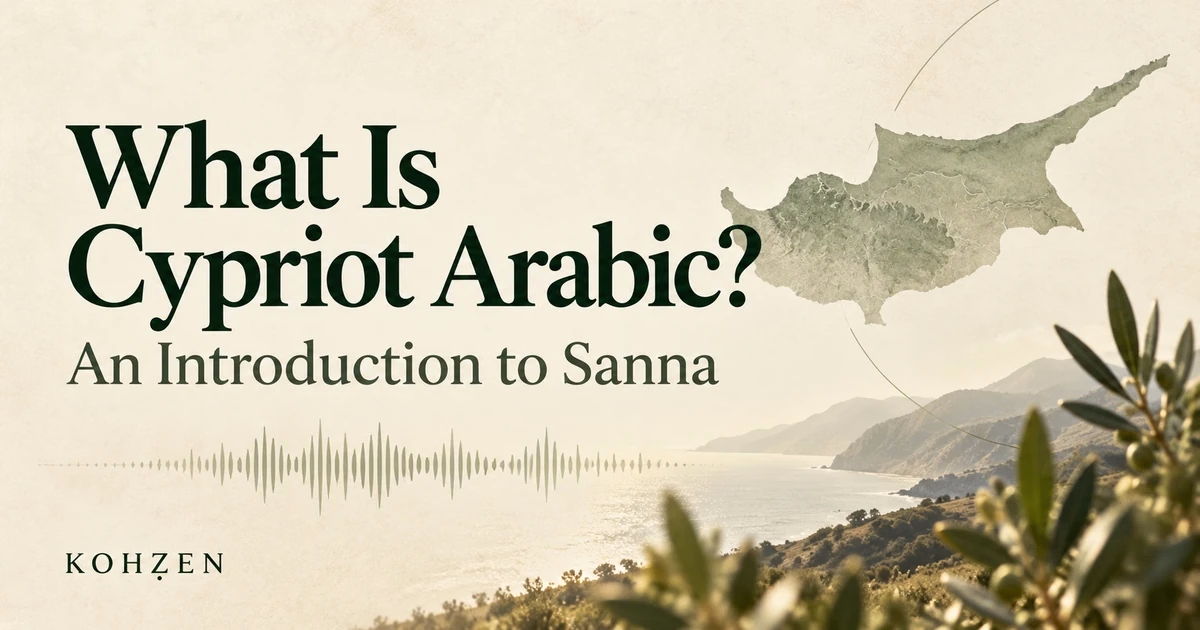
One of the most remarkable aspects of Cypriot Maronite heritage is Cypriot Arabic (Sanna), also known as Cypriot Maronite Arabic.
Sanna is an Arabic variety traditionally spoken by the Maronites of Kormakitis. It developed from Arabic brought to Cyprus through medieval migration from the Levant.
Over centuries, the language evolved in relative isolation from other Arabic-speaking communities while remaining in sustained contact with Cypriot Greek.
This history has produced distinctive vocabulary, pronunciation and grammatical features. Some elements reflect older Arabic developments, while others show the influence of language contact.
Sanna should not be confused with Syriac, the Aramaic language associated with Maronite liturgical tradition. Although both belong to the Semitic language family, they are distinct languages with different historical roles within the community.
Traditionally transmitted through everyday speech, Sanna became closely associated with family life and cultural identity in Kormakitis.
Its transmission was already weakening before 1974, but the subsequent displacement of villagers intensified the shift towards Greek.
Today, Cypriot Arabic is recognised as a severely endangered language variety. In November 2008, the Republic of Cyprus formally recognised it under the European Charter for Regional or Minority Languages.
Documentation, community teaching, oral-history projects and recordings are therefore particularly important to its future.
6. The events of 1974 profoundly disrupted Maronite village life
The events of 1974 marked a major turning point in the community’s modern history.
Following a coup in Cyprus backed by the Greek military junta, Turkey launched a military intervention that resulted in the island’s continuing division.
All four historic Maronite villages came under Turkish military control or administration, and much of the community was displaced from its homes.
The consequences extended far beyond the loss of property. Displacement separated families from village churches, neighbours, familiar landscapes and the settings in which traditions had been passed between generations.
A smaller number of residents remained in Kormakitis and Karpasha, preserving a continuing Maronite presence in the north.
Over time, changes in crossing arrangements and resettlement policies have allowed some former residents and their families to return, visit or re-establish a connection with their villages. Restrictions, property issues and practical difficulties nevertheless remain.
The Republic of Cyprus also introduced revised resettlement-support arrangements in 2024.
For many Cypriot Maronites, reconnecting with these villages is not simply a question of returning to a geographical location. It is about recovering an important part of community life.
7. Cypriot Maronite heritage continues to evolve
Despite displacement and social change, Cyprus’s Maronite community remains an active part of the island’s cultural and religious life.
Under the Republic of Cyprus’s Constitution, Maronites are recognised as a religious group and elect a representative to the House of Representatives, alongside the Armenian and Latin communities.
Maronite churches, community organisations, cultural events and family networks continue to sustain connections between generations.
There is also growing attention to the documentation and revitalisation of Cypriot Arabic, including linguistic research, recordings and community-led educational activities.
Yet the community’s heritage extends beyond language alone. It includes village histories, religious traditions, music, food, oral storytelling, family memories and experiences of migration.
Preserving this inheritance requires more than recording the past. It also means making space for the experiences and voices of people who continue to live it.
The Maronites of Cyprus: A living connection between the Levant and Cyprus
The Maronites originated in the Christian communities of the Levant and established a lasting presence in Cyprus through successive medieval migrations.
Their history reflects movement, adaptation, displacement and continuity across the eastern Mediterranean.
Over generations, Cyprus became more than a place of refuge. It became home to communities with their own villages, traditions and a distinctive Arabic language.
Today, that inheritance survives through people: the speakers of Sanna, the families who remember their villages, and those working to document and share the experiences of earlier generations.
At Kohẓen, this living heritage is central to our work. By documenting Cypriot Arabic (Sanna) and exploring the wider history of Cyprus’s Maronites, we hope to help make these voices and stories accessible to future generations.
Keep our voices. Strengthen our community.
Sources and further reading
- Republic of Cyprus, The Maronites of Cyprus — Government publication covering community history, migration, villages and cultural identity.
- Guita G. Hourani, A Reading in the History of the Maronites of Cyprus — Historical research examining migration accounts and the available documentary evidence.
- Contact-Induced Change in an Endangered Language: The Case of Cypriot Arabic — Academic research on Sanna, Greek language contact and language endangerment.
- Council of Europe: European Charter for Regional or Minority Languages, Cyprus report — Documentation of the Republic of Cyprus’s 2008 recognition of Cypriot Maronite Arabic.
- Cyprus Mail: Government simplifies criteria for resettlement in the north (2024) — More recent information on resettlement arrangements.