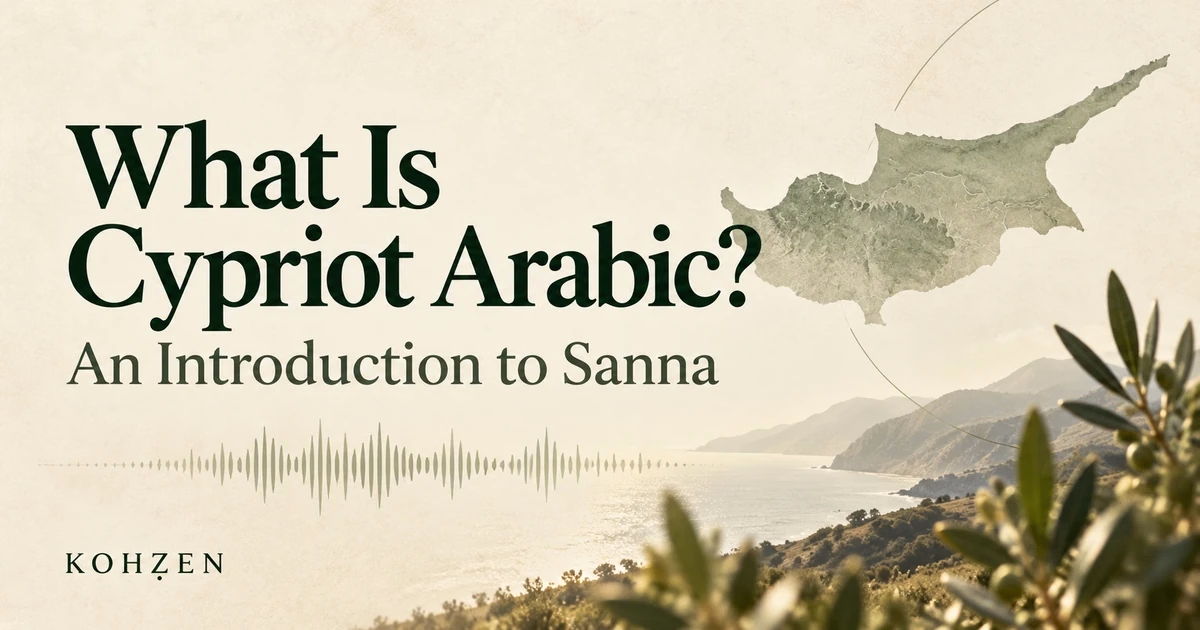
To understand Cypriot Arabic (Sanna), it helps to begin with a place: Kormakitis, also known as Kormajit.
Situated in north-western Cyprus, Kormakitis is a historic Maronite village whose language, churches and traditions have survived centuries of change. For generations, it was a place where Sanna was heard not only in family homes but also in the conversations, stories and everyday encounters that gave village life its character.
The events of 1974 transformed that world. Many residents were displaced, and the language’s transmission between generations became increasingly vulnerable.
Yet Kormakitis remains central to Cypriot Maronite identity. Its historic buildings, community memories and recorded voices offer a remarkable connection between the village’s past and its continuing cultural significance.
So what makes Kormakitis special, where does its name come from, and why is it so important to the future of Sanna?
- Where is Kormakitis?
- Where does the name Kormakitis come from?
- What was life like in Kormakitis before 1974?
- Why is Kormakitis important to Cypriot Arabic?
- The churches and religious heritage of Kormakitis
- What happened to Kormakitis in 1974?
- Is Kormakitis still inhabited today?
- Kormakitis’ museums and cultural preservation
- Why Kormakitis still matters
- Frequently asked questions about Kormakitis
- Sources and further reading
Where is Kormakitis?
Kormakitis is located in the Kyrenia district of north-western Cyprus, in the northern part of the island that has been outside the effective control of the Republic of Cyprus since 1974.
It is one of the four historic Maronite villages that remained into the twentieth century, alongside Asomatos, Ayia Marina and Karpasia.
The village is also known by several alternative names and spellings, including Kormajit, Kormacit and Koruçam. These reflect different linguistic and administrative contexts.
For the Cypriot Maronite community, Kormakitis occupies a particularly important position.
Although Maronites historically inhabited many settlements across Cyprus, Kormakitis became especially closely associated with their traditional Arabic language.
The University of Cyprus’ Sanna Oral Tradition Archive identifies Kormakitis as the village at the centre of its work documenting Cypriot Arabic and the experiences of its speakers.
Its importance, however, extends beyond language.
Kormakitis has long been a centre of Maronite religious, social and cultural life, with institutions and traditions that connect generations of families to the village.
Where does the name Kormakitis come from?
One of the most familiar stories about Kormakitis concerns the origins of its name.
According to a longstanding community tradition, the name is connected to Kour, a village in northern Lebanon associated with the ancestors of Kormakitis’ Maronite population.
The story is preserved in a phrase often rendered as:
Naxni jina u Kur majit.
In English, this is commonly translated as:
We came, but Kour did not.
The phrase expresses a sense of separation from an ancestral homeland, and it has become part of the village’s cultural memory.
In 2012, a stone monument was unveiled in Kormakitis’ village square to commemorate the traditional connection with Kour. The monument bears the phrase in Cypriot Maronite Arabic.
The Republic of Cyprus’ official publication The Maronites of Cyprus records both the monument and this explanation of the name.
Is that the historically established origin?
Not necessarily.
Although the Kour explanation is culturally important, it should not be presented as an uncontested linguistic fact.
In her 2018 research paper, Language Revitalization, Land and Identity in an Enclaved Arab Community in Cyprus, linguist Marilena Karyolemou discusses the traditional explanation as a popular etymology and identifies an alternative derivation associated with an older Greek place-name.
This distinction is important.
The traditional story helps explain how members of the community understand their relationship with Lebanon and their ancestral origins, even if the exact linguistic development of the village’s name remains debated.
Both the historical question and the cultural meaning deserve recognition.
What was life like in Kormakitis before 1974?
Much of Kormakitis’ heritage lies in the everyday experiences of the people who lived there.
During the British period, village residents were primarily involved in agriculture and farming, while other Maronites increasingly moved to towns such as Nicosia.
The village also developed institutions that supported local economic and community life.
In 1928, Kormakitis established a cooperative credit society, among the early institutions of its kind in Cyprus.
But an account of village life based only on dates, occupations and buildings would miss something essential.
Kormakitis was also a place of shared stories, family gatherings, religious celebrations and the familiar conversations through which community knowledge was passed down.
These experiences are particularly important to understanding Sanna.
The stories people told one another
The University of Cyprus’ Ten Small Stories in Sanna offers an unusually revealing glimpse into the village’s social world.
The collection brings together short narratives associated with life in Kormakitis before 1974.
Unlike conventional historical accounts, the stories do not focus primarily on major political events.
Instead, they recall everyday incidents, humour, misunderstandings and experiences remembered within the community.
Their titles include The Chicken Thieves, The Roasted Meat and the Onion and The Dragon’s Tooth.
The researchers explain that such stories were shared in settings including coffee shops, churchyards, weddings, baptisms and family gatherings.
Often, their purpose was not to tell listeners something entirely new.
It was to revisit experiences already familiar to the community, reinforcing a shared understanding of people, places and events.
That makes the collection particularly valuable.
It preserves not only examples of spoken Cypriot Arabic, but also something of the social environment in which the language was used.
Why is Kormakitis important to Cypriot Arabic?
Kormakitis is historically the principal centre associated with Sanna, the distinctive Arabic variety traditionally spoken by Cyprus’ Maronite community.
The language developed over centuries and was shaped by sustained contact with Cypriot Greek.
For much of its history, Sanna was transmitted primarily through speech rather than formal schooling.
The language therefore depended heavily on everyday interaction between generations.
In Kormakitis, these opportunities were embedded in village life.
Children could hear the language from relatives, neighbours and other members of the community, encountering vocabulary and expressions in natural settings.
This is one reason why recordings of older Kormakitis speakers are so important.
They preserve examples of pronunciation, storytelling and conversational language that cannot be fully reconstructed from written descriptions alone.
Hear the voices of Kormakitis
The University of Cyprus’ Sanna Oral Tradition Archive was established through a research programme supported by Cyprus’ Ministry of Education from 2013.
Its recordings document the language and the experiences of people connected to Kormakitis.
The archive includes original audiovisual material, educational resources and illustrated stories developed to help younger generations engage with Sanna.
These materials demonstrate an important connection between language and place.
A recording can preserve the words of an individual speaker, but understanding the circumstances in which those words were spoken helps preserve something of their meaning.
For those who grew up away from Kormakitis, hearing these voices may also offer a connection to experiences and traditions they did not encounter directly.
The churches and religious heritage of Kormakitis
Faith has long been central to community life in Kormakitis.
The village is home to several historic Maronite churches and chapels, reflecting centuries of religious continuity.
Among the most significant are two churches dedicated to Saint George.
Saint George’s Cathedral
The present Saint George’s Cathedral stands in Kormakitis’ village square.
According to the Republic of Cyprus’ official historical chronology, it was consecrated on 20 October 1933 by Maronite Archbishop Bulus Awad.
The cathedral became one of the village’s most recognisable landmarks and an important centre of Maronite worship.
Its significance extends beyond architecture.
For generations, churches such as Saint George’s provided places where religious celebrations, family milestones and community gatherings brought residents together.
The cathedral also houses an ecclesiastical museum established in 2010 with support from the Anastasios G. Leventis Foundation.
The Old Saint George Church
Kormakitis also has an older Saint George church, associated with the Franciscan Sisters’ convent.
According to the United Nations Development Programme (UNDP), the church dates to the sixteenth century.
It served as the community’s principal church until the construction of the newer cathedral.
Between July 2014 and September 2015, the building underwent conservation work supported by European Union funding.
The project included structural repairs, conservation of its historic wooden doors, improvements to its courtyard and the reconstruction of its bell tower.
This work illustrates another important dimension of cultural preservation.
Protecting heritage is not only about recording language and memories. It also means caring for the physical places through which a community’s history can still be encountered.
Other religious landmarks
The village’s religious heritage also includes the chapel of Saint George of Kornos, associated with the feast of Saint George of the Seed, and a historic chapel dedicated to the Virgin Mary.
Together, these buildings reflect the importance of religious life in Kormakitis and its longstanding place within Cyprus’ Maronite tradition.
What happened to Kormakitis in 1974?
The events of 1974 profoundly changed the village and its community.
Following Turkey’s military intervention and the division of Cyprus, Kormakitis came under Turkish control.
Many Maronite residents left their homes and settled elsewhere in Cyprus or abroad.
Others remained.
For those who stayed, everyday life was affected by the island’s division, changing access to services and the difficulties of maintaining community life under new circumstances.
For displaced families, the separation from Kormakitis was more than a geographical one.
It meant losing regular access to the village’s churches, familiar social networks and the places associated with family memory.
The effects on Sanna were particularly significant.
As families became dispersed, opportunities to use the language in everyday conversation became more limited.
Yet Kormakitis did not cease to be important to those who had left.
Family visits, religious celebrations and continued efforts to maintain a connection with the village helped preserve its place in community life.
Is Kormakitis still inhabited today?
Yes. Kormakitis remains inhabited, and it continues to hold importance for residents and families with ancestral connections to the village.
Its population and circumstances have changed considerably since 1974, however.
Some Maronites remained throughout the period following the island’s division, while others have pursued opportunities to return or resettle.
In recent years, government initiatives have included support for people wishing to establish or re-establish permanent residence in their ancestral communities.
The Republic of Cyprus’ revised resettlement scheme includes measures intended to support eligible residents in villages outside the Republic’s effective control.
Such initiatives are relevant to Kormakitis because community continuity depends partly on whether people can maintain a meaningful presence in the places associated with their heritage.
However, resettlement alone cannot guarantee the revival of Sanna.
Language use also depends on opportunities for learning, conversation and transmission between generations.
Kormakitis’ museums and cultural preservation
The village’s heritage is also preserved through community institutions.
According to the Republic of Cyprus’ publication The Maronites of Cyprus, Kormakitis has two particularly significant museums.
The Ecclesiastical Museum, established in 2010, is associated with Saint George’s Cathedral and the community’s religious heritage.
The Kormakitis Folkloric Museum, inaugurated in February 2012, was established through cooperation involving the Maronite Welfare Association of Cyprus, the Kormakitis Trust Heritage Club, public support and UNDP-related funding.
These institutions reflect the importance of preserving both religious traditions and the wider material culture of village life.
Their establishment also demonstrates the role of community organisations in maintaining connections to Kormakitis.
Heritage is not preserved solely through formal academic research.
It also depends on local initiatives, personal contributions and the knowledge of people whose experiences form part of the history being documented.
Why Kormakitis still matters
Kormakitis is more than a historic settlement associated with Cyprus’ Maronite community.
It is a place where several strands of heritage come together: language, faith, family memory, cultural traditions and the consequences of displacement.
Its buildings tell part of that story.
So do its museums, its community organisations and the families who continue to maintain connections to the village.
But some of its most distinctive heritage survives through voices.
Sanna carries expressions, memories and ways of speaking that developed through generations of life in Kormakitis.
This is why documenting the language matters.
An old story, a remembered expression or a recorded conversation can preserve details that might otherwise be lost as generations pass.
At Kohẓen, our current work focuses on making selected Cypriot Arabic recordings accessible through careful sourcing, working transliterations, English translations and cultural context.
We recognise the importance of acknowledging original sources, respecting permissions and being open about uncertainties.
Our aim is not to replace established archives or community preservation initiatives.
It is to contribute to making the voices and heritage associated with Kormakitis accessible beyond the village itself.
Hear Cypriot Arabic and explore Kohẓen’s recordings.
Frequently asked questions about Kormakitis
Where is Kormakitis in Cyprus?
Kormakitis is a historic Maronite village in the Kyrenia district of north-western Cyprus. It lies in the northern part of the island outside the effective control of the Republic of Cyprus.
Is Kormakitis the same as Kormajit?
Yes. Kormakitis and Kormajit are alternative names associated with the same village. Other recorded forms include Kormacit and Koruçam.
What language is spoken in Kormakitis?
Kormakitis is historically associated with Cypriot Arabic, known as Sanna. Today, language use varies between residents and generations, with Greek also widely used among Cypriot Maronites.
Why is Kormakitis important to the Maronites?
The village is an important centre of Cypriot Maronite heritage, with historic churches, community institutions and strong associations with the traditional language Sanna.
What happened to Kormakitis in 1974?
Following Turkey’s military intervention and the division of Cyprus, many Maronite residents were displaced from the village. Others remained, and efforts to maintain or re-establish community life have continued.
Can you hear traditional Sanna from Kormakitis?
Yes. The University of Cyprus’ Sanna Oral Tradition Archive includes recordings of speakers and stories connected to village life, alongside educational resources.
Sources and further reading
- Republic of Cyprus, Press and Information Office (2012): The Maronites of Cyprus. Historical account of the Maronite community, including Kormakitis’ churches, museums, monuments and experiences after 1974.
- University of Cyprus: Sanna Oral Tradition Archive. Research and documentation of Cypriot Arabic and Kormakitis’ oral heritage.
- University of Cyprus: Ten Small Stories in Sanna. Stories from village life, recordings and learning resources.
- United Nations Development Programme: Old Saint George Church in Kormakitis/Koruçam. Conservation project summary, 2014–15.
- Karyolemou, M. (2018): Language Revitalization, Land and Identity in an Enclaved Arab Community in Cyprus. Linguistic research examining the relationship between language, identity and place.
- Republic of Cyprus, Deputy Ministry of Social Welfare: Revised Resettlement Plan. Official information concerning support for eligible residents in affected communities.
Keep our voices. Strengthen our community.